Travel / Government
Citi X
Designing an end-to-end visa application and travel services platform.
A connected ecosystem for travellers, visa agents, corporate users, and internal administrators, from registration and submission to review, payment, processing, and decision.
- Role
- Product Designer
- Product
- Citi X
- Users
- Travellers · Agents · Corporate · Admin
- Scope
- Product Strategy · UX Design · UI Design
- Timeline
- [Add timeline]
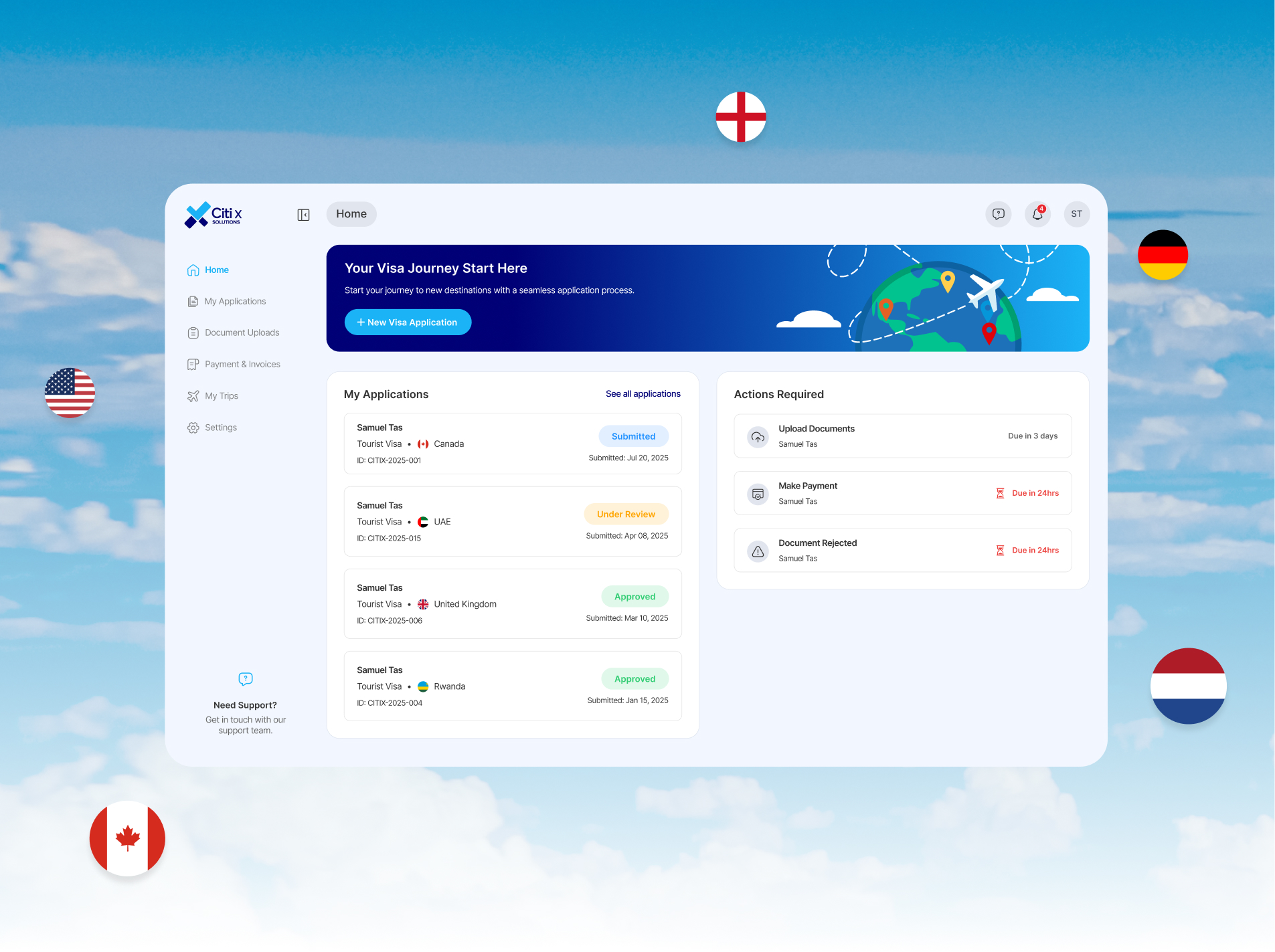
The problem
Visa processing was fragmented across too many touchpoints.
Applying for a visa involves more than completing a form. Users need to understand which visa they need, provide supporting documents, make payments, track progress, respond to requests, and receive a decision.
For agents and corporate users, the complexity increases further. They may manage applications for multiple travellers at once, while administrators review documents, update statuses, monitor transactions, manage users, and maintain visibility across the platform.
Travellers
Understand visa requirements, submit documents, confirm payment, track progress, and know what happens next.
Visa agents
Manage client applications, documents, payments, commissions, wallet activity, transactions, and communication.
Corporate users
Manage multiple travellers and group activity without treating every application as an isolated transaction.
Citi X admins
Review applications and documents, control statuses, monitor financial activity, manage users, and trace decisions.
How might we create one connected visa-processing ecosystem that makes the journey understandable for travellers, manageable for agents and corporates, and operationally controllable for Citi X?
The challenge shifted from “How do we design a visa application?” to “How do we design the entire system around the visa application?”
Placeholder, stakeholder journey
A four-part journey map showing the connected needs of travellers, agents, corporate teams, and Citi X administrators.
My thinking
I started with the ecosystem, not individual screens.
Instead of designing each page independently, I mapped the major actors and their relationship with the application. This exposed an important design principle: the application was the central object connecting most parts of the product.
Traveller
Register → Apply → Upload documents → Pay → Track → Decision
Agent
Manage clients → Apply → Documents → Payments → Commissions → Wallet
Corporate
Manage travellers → Group applications → Documents → Payments → Tracking
Admin
Manage users → Review → Update status → Transactions → Monitor → Configure
The application was the central object connecting most parts of the product.
Separate financial records from wallet operations
Treating payments, transactions, earnings, commissions, revenue, wallet activity, and invoices as separate primary destinations would create unnecessary complexity. I grouped historical financial records under Payments & Transactions and kept Wallet focused on money available to the user and wallet operations.
Payments & Transactions
What financial activity has happened? Application payments, commission records, refunds, statuses, references, methods, invoices, and receipts.
Wallet
What money is available and what has happened to it? Balance, funding, payments, commission credits, withdrawals, and history.
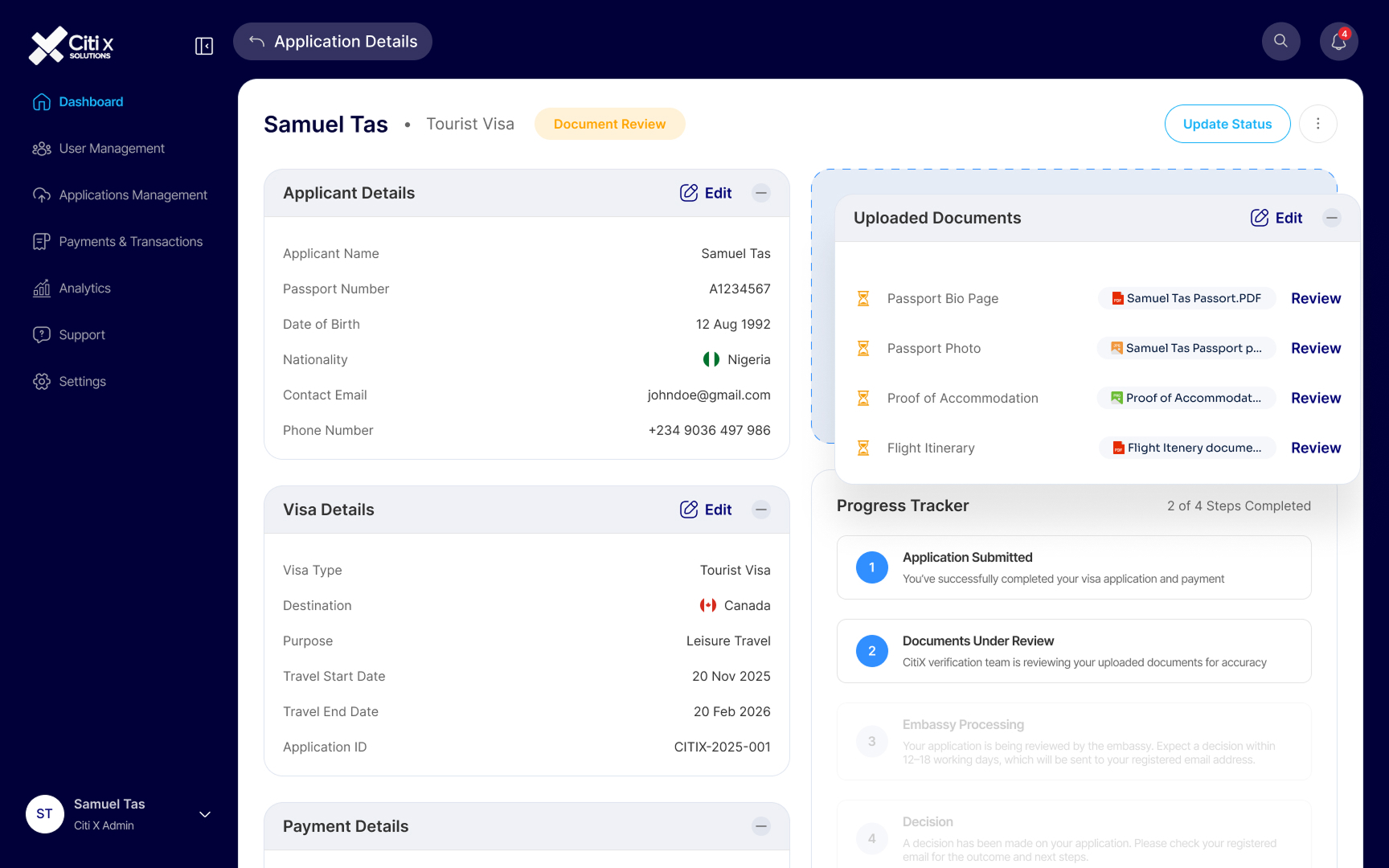
Design status as a journey, not just a label
A simple Pending, Processing, Approved, or Declined badge provides little context. A progressive tracker gives users a mental model of where they are and what comes next, reducing uncertainty throughout the process.
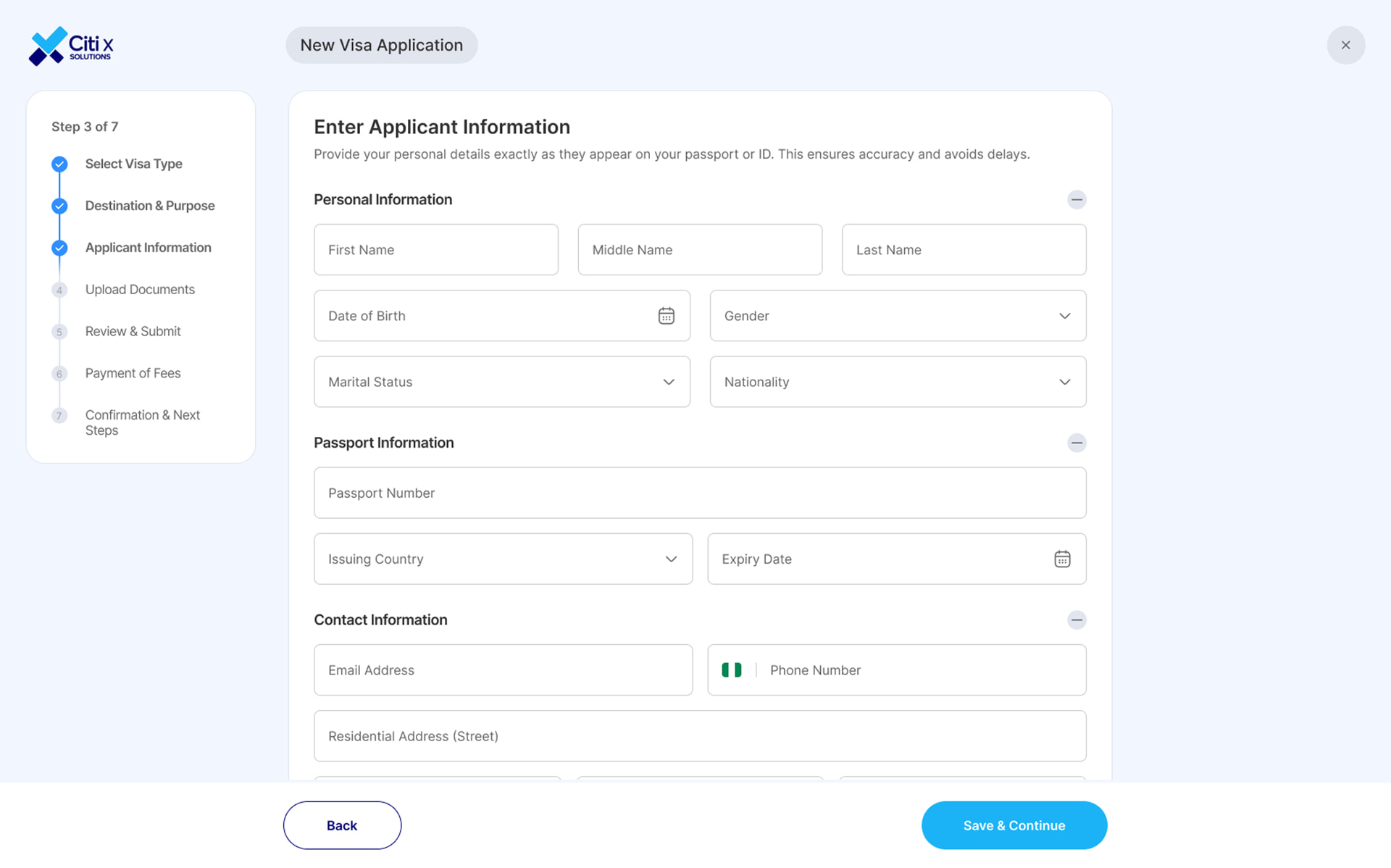
Separate application review from document review
An application can exist while individual documents are pending review, approved, or declined. Giving documents their own review interaction makes the workflow actionable and keeps the reason for any decline attached to the record.
Design the admin dashboard around decisions
Instead of filling the dashboard with generic charts, I structured analytics around actual platform activity and the questions administrators needed to answer quickly.
Application analytics
Totals, visa types, status distribution, and application trends.
User analytics
Travellers, agents, corporate users, registrations, and active users.
Financial analytics
Revenue, payments, commissions, wallet activity, and transaction trends.
Operational analytics
Applications awaiting review, document activity, processing, and system issues.
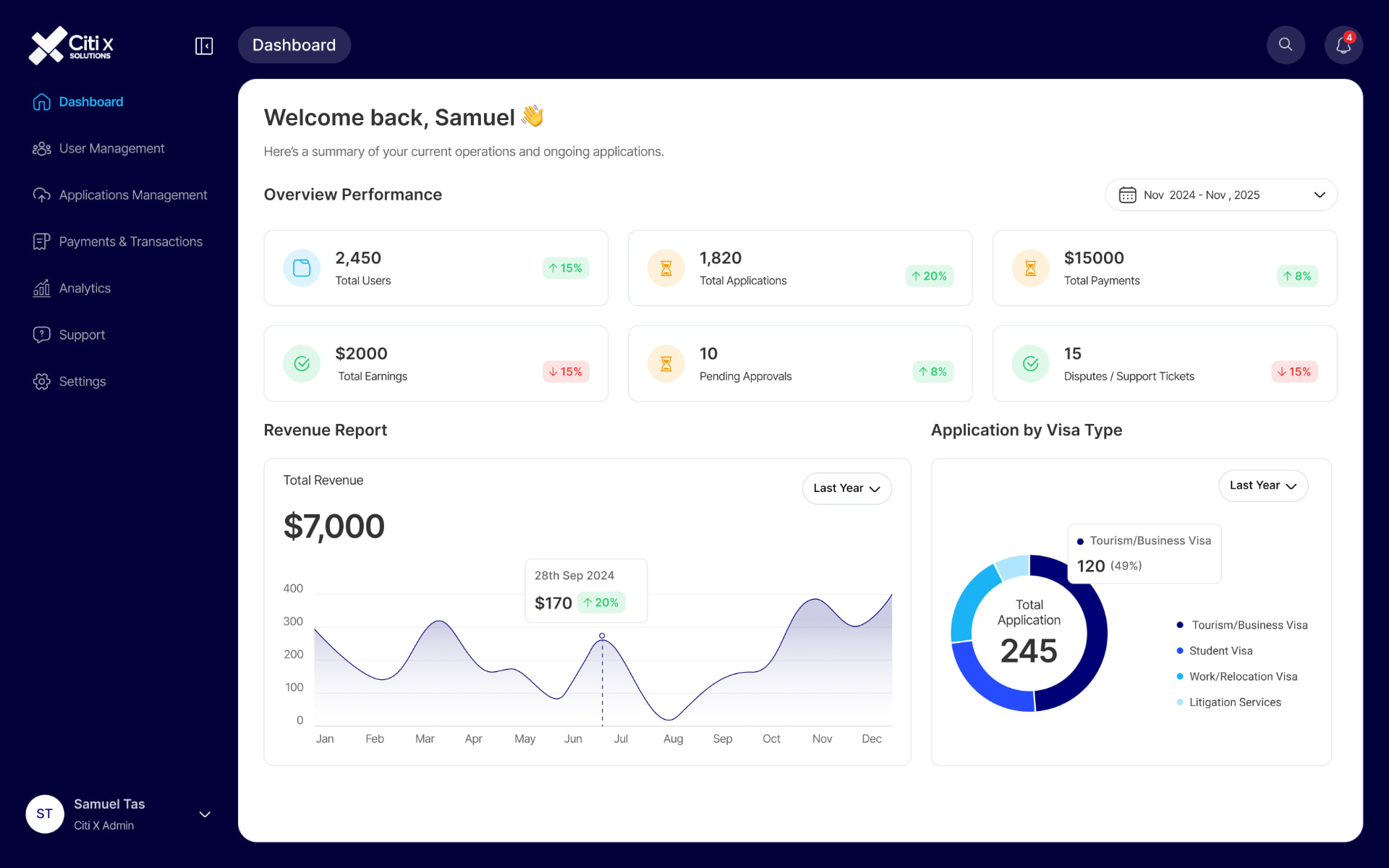
Keep service categories consistent
Tourism and Business Visa, Student Visa, Work and Relocation Visa, and Litigation Services stay consistent across forms, dashboards, analytics, and tables to reduce cognitive load.
Design for different levels of complexity
The goal was not to give every user the same interface. The goal was to give each user enough functionality for their job without exposing unnecessary complexity.
Individuals
Application → Documents → Payment → Status → Decision
Agents
Clients → Applications → Documents → Payments → Commissions → Wallet
Corporate
Travellers → Group applications → Documents → Payments → Tracking
Key design tradeoffs
Simplicity vs. financial visibility
Consolidate financial records while keeping Wallet focused on available money and operations.
Status simplicity vs. operational detail
Show major stages in a progressive tracker and keep detailed information inside the application.
One flow vs. different user needs
Use the application as the shared core, then tailor surrounding workflows to each role.
Admin control vs. user transparency
Connect internal actions to visible tracker updates and user notifications.
The business
Citi X needed more than a visa application form.
The business was building a platform for individual travellers, visa agents, and corporate customers, supported by applications, document processing, payments, commissions, wallets, user management, reporting, and analytics.
The product needed to support both customer acquisition and operational scalability.
A platform model, not a single-user product
The tiered direction required a flexible architecture that could introduce differentiated capabilities without rebuilding the core experience for every user type.
Individuals
Simple visa application and tracking.
Agents
Client management, group applications, commissions, and operational workflows.
Corporate
Advanced management for larger teams and multiple travellers.
Support revenue without compromising the experience
Payment was not treated as an isolated checkout screen. It remained connected to the application lifecycle, so users could understand what they were paying for, why they were paying it, and what happens next.
Placeholder, payment lifecycle
Application fees, payment confirmation, receipt, and the resulting application-status update shown as one connected experience.
Build operational scalability into the product
Structured application management, document review, status updates, transaction records, user management, analytics, and activity history provide the operational foundation needed to manage a growing platform.
The constraint
There were many actors, workflows, and financial concepts, but the interface still needed to feel simple. The central question became: how do we expose the right information at the right moment without making the platform feel complicated?
Design principle
Complexity should exist in the system, not in the user’s head.
The platform may need to manage applications, documents, payments, commissions, wallets, users, statuses, and administrative controls. Each person should still see only the information required to understand their next step.
Traveller
What do I need to do? Where is my application? What happens next?
Agent
Which clients need attention? Which applications are progressing? What have I paid and earned?
Administrator
What needs attention? What is happening across the platform? Where are the operational or financial issues?
Placeholder, connected platform
A final system map showing how applications connect travellers, agents, corporate teams, administrators, documents, payments, wallets, and status updates.
Outcome
Verified post-launch metrics will be added when available. No performance or conversion figures have been assumed.